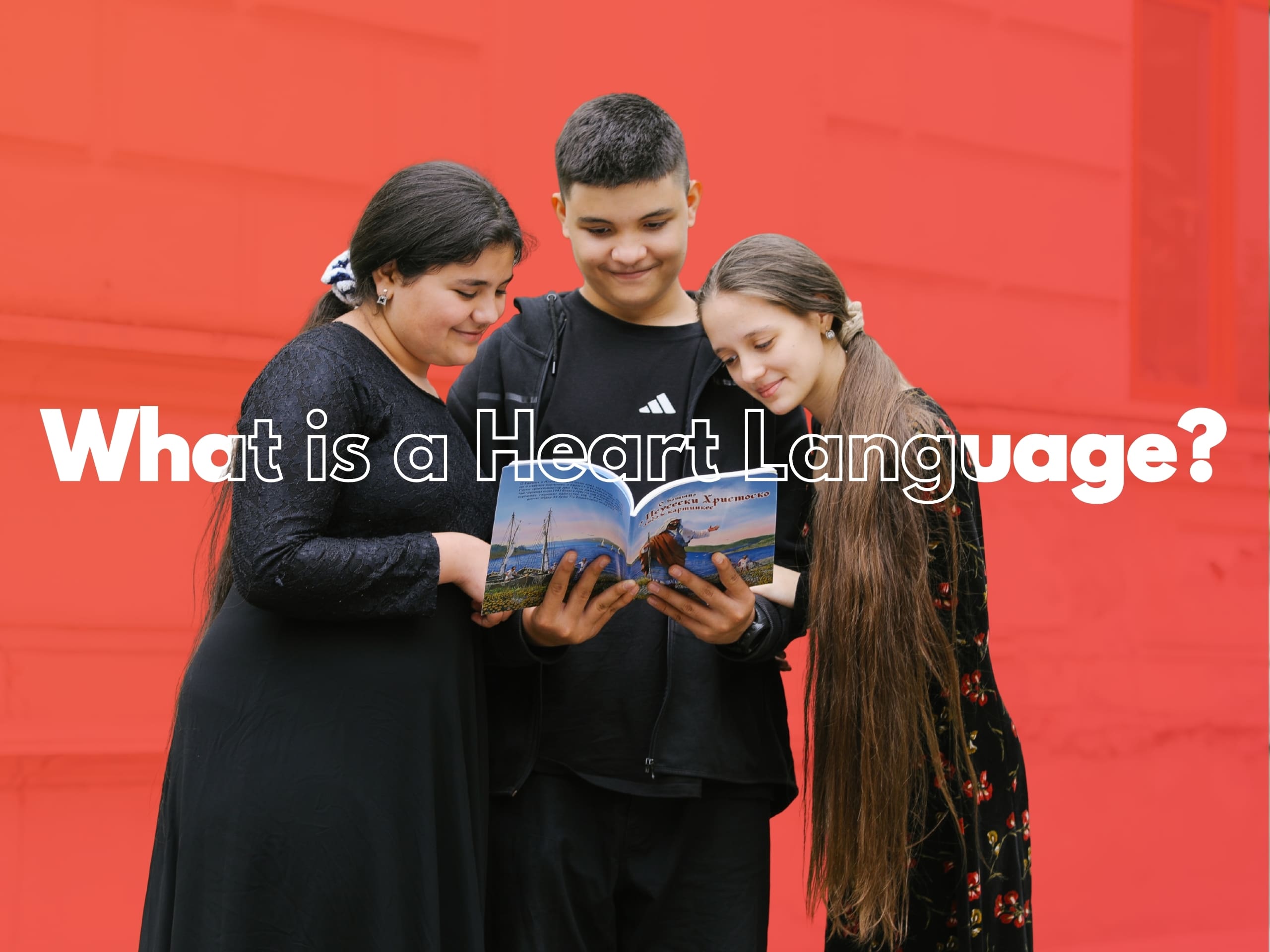
Why Bible Translation is About More Than Words
The importance of heart language may be difficult to understand for those who have grown up in a setting where the majority language is their first (heart) language.
Many people of the world are multilingual, especially in areas like Eurasia, Africa, Papua New Guinea, and other places where Pioneer Bible works. They speak their own distinct language at home and in their communities, but they also use the common language in their region. Many people speak at least two or three languages, sometimes more.
So what is a heart language? Why are they so important? And why is it so important for someone to have the Bible in their own heart language?
The Language Veil
I remember an experience I had when I was in college learning Spanish that illustrates the difference between a heart language and a second language.
I bent over the words on the page of my Spanish literature textbook, trying to piece together what the story introduction was describing.
“Arturo de Miracielos (un joven muy hermoso pero que, a juzgar por su conducta, no tenía casa ni hogar) consiguió cierta noche, a fuerza de ruegos, quedarse a dormir en las habitaciones de una amiga suya, no menos hermosa que él, llamada Matilde Entrambasaguas…”
I translated in my mind as I read. “Arturo was a very handsome man, but judging by his conduct he had neither a house nor a home, and by virtue of begging, he got to sleep in the rooms of his beautiful friend Matilde.”
I felt like I was looking for the answer to a riddle but was missing something important. I sat back, squinting at the text. I couldn’t figure out the characters. It felt like one of them was an antagonist, but I couldn’t decide which one or why.
So … I think Arturo was a homeless beggar? And Matilde is showing him kindness and compassion by letting him stay in her home? But I guess her husband is mean, because he wouldn’t have let Arturo stay if he hadn’t been away?
It was only after I talked with a fellow classmate that I discovered what the short story introduction actually meant: Arturo and Matilde were having a love affair while Matilde’s husband was out of town on business.
Wow, what an embarrassing misunderstanding.
I knew what each of the words meant, but I didn’t understand the tone or implications of what I was reading. If I’d read the story in English — the language I grew up speaking — I would have caught the subtext right away. But I only understood the individual words, rather than the whole meaning, because my mind didn’t operate well enough in Spanish to piece together what was happening in the story.
That’s the difference between a heart language and a second language.
For me, trying to read literature in Spanish was like trying to look at the paintings in the Sistine Chapel through a cheesecloth or a veil: I could make out figures and colors, and I could probably figure out what’s going on. But the nuance — the beauty and the impact — is lost through the unfamiliarity of the lens and the effort it takes to see past the obstacle.
What is a Heart Language?
Many people usually have a functional understanding or are fluent in one or more neighboring languages, the languages of surrounding villages, populations, regions, or countries. They also are familiar with their country’s language of wider communication (LWC), which is a more widely spoken national or trade language such as Standard Arabic, French, Spanish, English, or Hindi.
So why isn’t a Bible that already exists in one of those languages sufficient for them? Why do they need a Bible in their own language?
For these people groups, the language they speak at home and within their cultural communities is their heart language. This heart language is the language they think and pray and dream in.
The heart language is the one in which people connect and understand most deeply — the language that speaks not just to their heads but to their hearts.
It’s the language in which they learned how the world worked and connected words to ideas for the first time. It’s the language where words become three-dimensional and alive for them instead of staying flat on the page. Usually (although not always) it’s the first language they learn.
It’s also the language they connect to and understand the most deeply — the language that speaks not just to their heads but to their hearts. The heart language — the language a person learned from childhood and speaks most naturally — is where a person most fully understands concepts and ideas.
Communication is deeper than words alone. Every language has echoes and cultural implications attached, every language has layers of meaning in the structure and content that extend beyond dictionary definitions and official grammar. There are nuances of tone, figures of speech, underlying implications, and historical background.
Understanding these nuances and echoes is instinctive and natural in the heart language. But when someone learns a second or a third or a tenth language, it’s difficult to grasp more than the surface of the word’s meaning. They are not familiar enough with the language to recognize nuance and have a full understanding.
Heart Languages and Scripture: An Example
The Banyamulenge are a people group from the Democratic Republic of Congo, and their heart language is Kinyamulenge. However, many of the Banyamulenge are scattered through surrounding countries such as Rwanda, Uganda, and Burundi.
As a result, most Banyamulenge individuals have a functional understanding of regional languages like Kinyarwanda and Kirundi. Furthermore, Swahili and French are the primary languages of East Africa, so the majority of Banyamulenge are fluent in one or both.
Most Banyamulenge can communicate and operate in four or five different languages. But the language that the Banyamulenge understand best is Kinyamulenge. And even if the Banyamulenge were fully fluent in all four of the other languages — Kinyarwanda, Kirundi, Swahili, and French — Kinyamulenge is still usually the heart language that the Banyamulenge use with their family and that they engage with emotionally.
This is why heart languages are so important for Bible translation. It’s not enough for a person to read a Bible in a common language like Arabic or English or French. Just like I didn’t understand the subtext of the Spanish literature I was reading, it’s almost impossible for them to understand the full depth and implications of the Gospel through the veil of a different language.
That language veil makes it much harder for the Gospel to sink in or bring significant transformation. It will not reach people’s hearts. But hearing the Gospel in their own language will resonate in their hearts and transform people’s lives.
People realize God loves them when they get to experience the fullness of the Gospel in their heart language. Even the fact that He speaks to them in their language shows them that He cares about them.
People realize God loves them when they get to experience the fullness of the Gospel in their heart language.
I think of the veil in the temple that separated the people from the presence of God in the Holy of Holies. Matthew 27:51 tells us that at the moment of Jesus’ death, that veil “was torn in two, from top to bottom” (ESV).
Jesus’ death gave all people freedom to approach God and to have a relationship with Him. There is no separation between us and Him, and we don’t have to go to a temple or an earthly priest to meet Him. We are free to draw near.
But for people who do not have Scripture in their heart language, they are still separated from an intimate understanding of God by the language veil they are forced to see Him through. Scripture in their heart language removes that veil and allows them the joy of deeper understanding and relationship with their Creator and Savior.
Read more stories of what happens when the language veil is removed: