Southeast Christian Church, a massive church campus in Louisville, Kentucky, is a flurry of activity on a Sunday morning. Worshippers flood out of the many sets of glass doors into the parking lot. Their early service has just ended. More worshippers trickle in — some headed to fill the pews of the main sanctuary for second service but others headed in the other direction, up a set of stairs to Multination Fellowship.
The Banyamulenge, a people group from East Africa, make up the majority of this congregation. Most Banyamulenge are refugees, fleeing over the course of decades from a brutal, ongoing ethnic cleansing. Through this, they have clung to a tradition of faith — and even deepened it.
“And our visitors, our brothers and sisters, we are glad you are here!” the pastor announces after the opening prayers and Scripture readings. “Everyone who is new today, please stand so we can welcome you.”
On the left side, two girls stand. In the front few rows, a husband and wife. The congregation extends their hands towards the nearest visitor and Kinyamulenge, Swahili, English, and Kinyarwanda blend in response: “Welcome, brothers and sisters. God bless you for being with us. Amen.”
Piano, drums, and electric guitar blast through the chapel. There are a few singers in the front row of the worship team. The rest grab amapendos, tin boxes full of beads. Slowly the rhythms speed up. The song moves faster and faster until the singers put down their mics and dance, their steps quick and rhythmic, almost like running in place. This song and dance, the igisirumba, are “prayer and praise wrapped all together,” according to missionary Brenda Webb. Dancers shift across the stage, making their way to the front to jump and dance with more energy. Some congregants step in place at their seats — their movements smaller but just as bouncy.
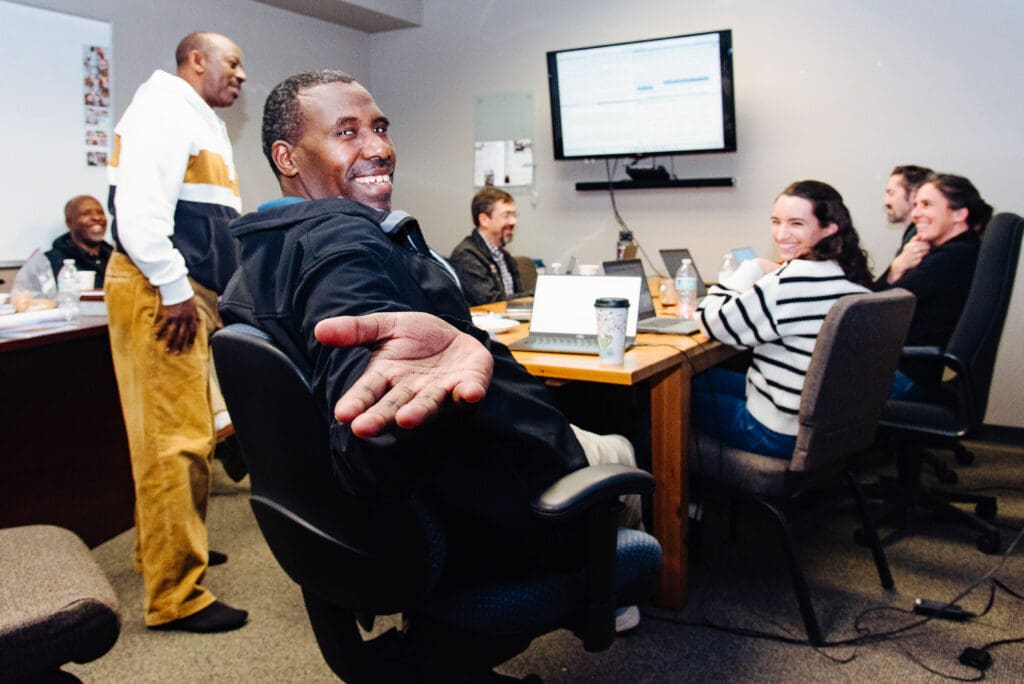
Pastor Philemon, Pastor Tito, and Pastor Robert are working to translate the Bible into their language, so that they can share God’s true character and faithfulness with their congregations. They are in Multination Fellowship’s pews this morning, videotaping the igisirumba so as not to lose this moment. “They worship with their entire being,” Brenda explained. “There’s no one who worships like the Banyamulenge.”
Beneath their joy on Sunday morning lies deep, unhealed trauma.
Debora, the daughter of one pastor-translator and daughter-in-law of another, is passionate to see her entire community find the kind of healing she found through trauma care lessons. “Believe me, the scars are so deep. Some of them are not scars — they are still very fresh wounds. The surface level is dried up, but there’s internal bleeding.”
Beneath their joy on Sunday morning lies deep, unhealed trauma.
The scars the Banyamulenge carry are many and varied. Healing means unpacking both visible and invisible traumas. The older generation — the pastors, the grandparents — lost their homes, livelihoods, and family members, and held on to their traditions in new countries with new cultures. Their children grew up in transition, fleeing from country to country as refugees, searching for safety and identity. The youngest generation — the community’s young adults — balance their Banyamulenge heritage with their integration into American culture and struggle to pinpoint a homeland. Trauma care classes and training seek to equip the Banyamulenge to lay this pain at the foot of the cross and find mental, emotional, and spiritual healing.
Later in the week, Debora told a traditional Banyamulenge story to describe the intersection of experiences and faith in her community.
“So you’ve seen the story of the elephant and the blind men? It’s a story of an elephant and six blind men that were touching the elephant in different parts. Each of them described whatever part they were feeling. The elephant is big, so whoever touched the tusk, whoever touched the trunk, whoever touched the leg, whoever touched the belly — everyone obviously had a different description. Are they all wrong?”
Debora waits a moment for emphasis. “No, they just have different perspectives of the elephant. Depending on what you’re going through, that’s how you experience God,” she explains. “As Banyamulenge, because of all the wars, we know God our Rescuer.”
“Depending on what you’re going through, that’s how you experience God. As Banyamulenge, because of all the wars, we know God our Rescuer.”
The Kinyamulenge word Umutabazi means God the Rescuer. The Banyamulenge worship Umutabazi with enthusiastic joy because of how He has delivered them, and they cling fiercely to Him for yet more deliverance. While this community has found comparative safety in Kentucky, the conflict they fled in the 1990s continues today — as shown by a sympathy card on a table in the Bible translation office.
The card honors a cousin lost to the fighting. Pastor Robert is a quiet, grandfatherly man with a sparkling sense of humor, but he grows solemn to explain: “Last week, you know, they carry and they took [his] head. And they take a picture, and they send.” Banyamulenge in Eastern Africa could be killed in their homes, by their neighbors, at any time.
This card is a physical reminder that God Umutabazi is their source of joy, because He is their source of rescue. But even after rescue, the Banyamulenge continue to face so much trauma that it becomes commonplace. “We grieve in [community],” Debora explained, “and then you have to go back to day-to-day life.”
When asked, Are you okay? the Banyamulenge will often answer with turakomeye, a phrase that means we are strong or we are keeping on. It can also mean together, we are strong. Brenda has heard it used to help somebody feel like they’re not alone.
Pastor Philemon explained that in poverty, the Banyamulenge have had to say to themselves, “‘Okay, we don’t have the food to give to kids. We don’t have milk to give to the kids.'” But they pushed through and figured out how to survive. In war zones, he said, “We lost our cows. We lost our relatives. We lost our houses.” But they rebuilt — again and again.
Muscling through fear, grief, anger, and hopelessness allowed the Banyamulenge to survive, but their emotions remain to be processed. It can be a challenge to understand why such an immaterial wound exists, much less why it needs to be dredged up and healed.
Trauma care is “a way to practically help the people group we serve,” Brenda explains. It equips participants to “drill down to what is causing them pain in the moment” and “find an answer for themselves on what they can do.” Each session of the weekly class addresses a different aspect of mental health and trauma.
“You are living with someone who is wounded, but you don’t know if he’s sick,” Philemon says, describing how his community used to view trauma reactions. “We [were] thinking, ‘Oh, maybe she’s sick.’ Maybe she has something.”
“We didn’t know that the trauma is inside,” Philemon continued. “Now, many people will express it, and they will talk about it, and then there will be a healing.”
Jehovah-Rapha is Hebrew for the God who Heals. The trauma care program aims to draw participants near to the God who Heals, so that they might “expand and grow in who Jesus is, and how they can relate to Him, and how they can grow their relationship with Him,” Brenda explains. True healing comes only from the true Healer.
A lesson on grief includes discussion of Jonah and Biblical grief. “I was angered at the time,” Debora shared, “because it was very fresh that the military general who was protecting our community, back home, had just died — a few weeks prior to the lesson. And it was still fresh, and I was very angry.”
But, the lesson asked, what does God say about anger and grief? “We read about Jonah,” Debora continued. “And I like that Jonah felt very angered about the whole situation with the people who attacked his people.”
In the story, God is very gentle with Jonah, continually drawing him back to obedience, listening patiently to his complaints, and allowing him to emotionally react. “My grief — I never got a chance to grieve it very well,” Debora said. “But to see it in the Bible, it gave me permission to grieve.”
Because Scripture undergirds all the teaching, trauma care participants can be healed much more deeply. “I was reintroduced to God,” Debora shared. “I was reintroduced to myself. I was reintroduced to my family.” Healing in all areas of life flows out of a dependence on Scripture. The Banyamulenge are no strangers to relying on Scripture, and a deepened dependence can only strengthen their faith
Healing in all areas of life flows out of a dependence on Scripture.
The igisirimba — prayer and praise wrapped all together — is a regular part of the service at Multination Fellowship. “You can just tell when they’ve got something really heavy on their hearts,” Brenda said. Sometimes the igisirimba lasts over an hour. The tradition to worship and come to God is strong, “whether it’s a joyful thing, or whether it’s something that they’re really struggling with and they’re up there trying to give it to God.”
The Banyamulenge know Umutabazi — the God who Rescues — but they need to know He is also Jehovah-Rapha — the God who Heals. Their joy, so strong even through continual trauma, would be enriched by peace that passes understanding. Debora hopes to see her community say, “Cry now, but even through your crying, remember you have hope.’”
“We know God our Rescuer. But this trauma and healing exposed me even more to God our Restorer, God our Redeemer, God our Present Help,” Debora emphasized. “I got to experience a different side of the elephant.”